
President Droupadi Murmu has withheld assent to three amendment Bills passed by the West Bengal Assembly, which sought to replace the governor with the chief minister as chancellor of state-run universities.

Congress leader Rahul Gandhi, who made "number 16" jibe at the treasury benches during his speech in Lok Sabha on Friday on three new bills, refused to elaborate on it in his brief interaction with reporters and said "it is a puzzle" and he "won't tell the answer just like that".
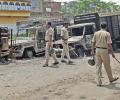
West Bengal Chief Minister Mamata Banerjee has accused central forces of searching her car and criticised the BJP for alleged election misconduct during a rally in Islampur, Uttar Dinajpur district.

The Supreme Court of India has ruled that a governor has discretion under Article 200 to refer a state bill to the President or return it to the legislature, and is not bound by the advice of the council of ministers. The court clarified that a governor cannot simply withhold a bill.

Indian stock markets are set to be influenced by developments in US-Iran negotiations, crude oil prices, and foreign investor activity in the upcoming holiday-shortened week, according to market analysts.

West Bengal Chief Minister Mamata Banerjee criticised the BJP for allegedly attempting to divide people on religious and caste lines during a community outreach programme in her Bhabanipur constituency.

A viral video of a woman confronting a Maharashtra minister over traffic jams caused by a BJP rally has sparked a backlash, forcing the ruling party to defend its actions and prompting apologies for the inconvenience caused to commuters.
West Bengal Chief Minister Mamata Banerjee criticised the BJP for allegedly deleting names from electoral rolls and attempting to divide people on religious and caste lines during a community outreach programme in her Bhabanipur constituency.

Defence Minister Rajnath Singh on Sunday slammed the Congress and DMK over the defeat of the amendment bill regarding the Women's Reservation Act in Parliament but said the government was determined to implement it and that "no power in the world can stop us," from doing so.
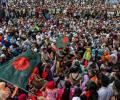
Union Health Minister J P Nadda launched a scathing attack on the TMC in West Bengal, accusing it of appeasement politics, shielding infiltrators, and presiding over a corrupt and lawless regime.

'What exactly is on the prime minister's mind, we do not know. But it feels like the government wants the country to be prepared for unseen challenges ahead.'
The Reserve Bank of India has updated its e-mandate framework, allowing card issuers to map existing mandates to reissued cards and clarifying rules around transaction limits and customer grievance redressal.

Insights from behavioural economics suggest that an ambitious nudge can be effective if three conditions are met, points out Ram Singh Insights from behavioural economics suggest that an ambitious nudge can be effective if three conditions are met, points out Ram Singh, director, Delhi School of Economics.

The operator's liability in the case of an incident is limited to 3,000 crore for reactors with thermal power above 3,600 Megawatt; 1,500 crore for reactors with thermal power between 1,500 Mw and 3,600 Mw; 750 crore for reactors with thermal power between 750 Mw and 1,500 Mw; 300 crore for reactors with thermal power between 150 Mw and 750 Mw; and 100 crore for reactors having thermal power up to 150 Mw, fuel cycle facilities other than spent fuel reprocessing plants and transportation of nuclear materials.

Reservation bill passed in Maharashtra Assembly amid din over blasts
A parliamentary standing committee has cleared the bill seeking amendment in the Constitution for women's reservation in the Lok Sabha.

A complaint has been filed against a woman who confronted Maharashtra minister Girish Mahajan over a traffic jam caused by a BJP rally in Mumbai, police said.

The All India Football Federation (AIFF) has added five players to the national team for the Unity Cup in London after Mohun Bagan Super Giants withdrew their players. The AIFF is working to secure visas for the new players before the first match against Jamaica.

What is missing in the BJP's armour is dominance over 50 percent of the electorate: Women. And this is a gamble Modi-Shah have indicated that they are willing to take, explains Saisuresh Sivaswamy.
The Sri Lankan government attributes the sharp depreciation of the rupee against the US dollar to the ongoing conflict in West Asia, citing increased costs for essential imports like gas, fertiliser, and oil.
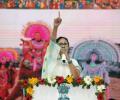
The BJP's West Bengal unit chief, Samik Bhattacharya, criticised the Trinamool Congress (TMC) government, accusing it of crushing democracy and fostering lawlessness in the state. He highlighted alleged political violence, economic decline, and disrespect for constitutional posts under the TMC's rule.

'Even last year, when India bought gold, the physical quantity was much less than the previous years.'

A court in Maharashtra's Nashik district on Monday fixed May 2 for giving its verdict on the anticipatory bail plea filed by TCS employee Nida Khan, an accused in a case related to alleged sexual harassment and forcible religious conversion at the IT firm's local unit.

Congress MP K C Venugopal has submitted a privilege notice to Lok Sabha Speaker Om Birla against Prime Minister Narendra Modi, alleging breach of privilege during a recent address to the nation.
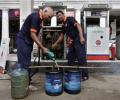
A Monaco-based fuel technology company, FOWE Eco Solutions, claims its patented Cavitech fuel emulsion technology can help industries slash fuel consumption, reduce emissions, and improve equipment performance by using water in fuel.
A Monaco-based fuel technology company, FOWE Eco Solutions, claims its patented Cavitech fuel emulsion technology can help industries slash fuel consumption, reduce emissions, and improve equipment performance by using water.
A Monaco-based fuel technology company, FOWE Eco Solutions, claims its patented Cavitech fuel emulsion technology can help India reduce fuel consumption, emissions, and improve equipment performance by using water in a fuel-oil-water emulsion.
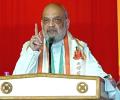
Union Home Minister Amit Shah refuted claims that southern states will have reduced representation in the Lok Sabha after the implementation of women's reservation and delimitation of constituencies, assuring an increase in both the number of seats and percentage of power.
Union Home Minister Amit Shah refuted claims that southern states will have reduced representation in the Lok Sabha after the implementation of women's reservation and delimitation of constituencies, assuring an increase in both the number of seats and percentage of power.

'Present day youth are not interested in the past. They want to see what you are going to do now.'

The Indian government has introduced a bill to overhaul the civil nuclear sector, allowing private participation and establishing a new liability regime. The SHANTI Bill, 2025, aims to repeal existing acts and address industry concerns.

Petrol price has been increased by 87 paise in Delhi from Rs 98.64 to Rs 99.51 per litre. Diesel rates have gone up by 91 paise from Rs 91.58 to Rs 92.49.

BJP leader Nitin Nabin accuses the Mamata Banerjee-led TMC government of altering West Bengal's demography by favouring infiltrators and neglecting the rights of the state's residents, promising to rectify the situation if the BJP comes to power.

The Strait of Hormuz crisis is impacting lifestyles worldwide, from reduced gold purchases in India to energy conservation in Europe and Japan, as governments urge citizens to adapt to the global energy shock.

'In all these years of rupee depreciation, of rising oil prices, of inflation caused by import dependence, not one leader had the courage to look the people in the eye and say: Please do this for your country.'

Bank of Baroda has partnered with Reliance Jio to provide access to its mobile banking application, 'bob World Lite', for users of Jio feature phones, aiming to promote financial inclusion and digital payments.

Petrol and diesel prices in India have been increased for the second time in a week, following a long freeze on revisions. The increase comes as global crude prices surge and state-run oil firms look to recoup losses.

Petrol and diesel prices in India have seen their fourth increase in less than two weeks, pushing cumulative hikes to nearly Rs 7.5 per litre since May 15, reaching their highest levels since May 2022. This surge, driven by global crude oil costs and the Iran conflict, is expected to exacerbate inflationary pressures and raise transportation costs across the economy.
The Rajasthan High Court has revised its transgender reservation judgment, reaffirming the constitutional right to self-identify gender while addressing concerns about the 2026 Amendment Act's impact on transgender rights.

BJP MP Anurag Thakur believes PM Modi's purchase of 'jhalmuri' in Jhargram will influence the West Bengal Assembly polls, contrasting it with CM Mamata Banerjee's actions. He also criticised the TMC government for blocking central schemes and failing to ensure women's safety.
